I’ve so far spent a lot of time on this blog moaning away about things I don’t like, whilst providing no real suggestions for how to improve matters. Well, things are going to change. Now, my furry friends, I introduce you to a new section on this blog where I propose innovative solutions to the problems faced by modern America. I know Obama reads the internet a lot, so I’m hopeful that some of these will be put into practice.
Let me start with a small amount of ill-researched and probably incorrect history. Many years ago, in 43 AD, the Romans were getting restless. They yearned for adventure, were sick of the nice weather and had a hankering for some fish and chips. Emperor Claudius thought that a fun way to get these things would be to invade Britain. A quick look at the map revealed that it was a long way away, but they set off anyway with high hopes, cheerful spirits and plenty of salt and vinegar. They turned up in England, and were somewhat disappointed with the calibre of the locals, who turned out to be greasy savages with a language so preposterously unstructured that it took several hours of debate to conjugate a verb.
After a couple of brief fights on the beach, the Romans realised that the best way to curry favour with the filthy Brits was to give them free stuff. They got to work building some lovely roads, and after a few weeks managed to start striking deals with local landowners. Before long, the English were building Roman-style villas, wearing togas, zooming around on Lambrettas and smoking Marlboro Lights. The Romans didn’t really do a lot of fighting until they got to Scotland, where the locals thought scooters were gay and preferred grease-induced heart disease to lung cancer. Still, until they hit Scotland the Romans had a pretty good proof of concept for the “cake or death” style of conquest.
Some years ago, America president George W Bush invaded a country called Iraq. He was angry with Iraq because its residents looked similar to a guy who’d been causing America some trouble, and because that guy probably lived somewhere nearby. The Americans got rid of the government pretty quick but, as is the case with many invasions, the local population were irritated and did their best to spoil all of Bush’s attempts to make a new government. This went on for ages, until Bush wasn’t reelected and didn’t have to worry about it any more.
Back home in America, there were yet more problems. The American car industry had suffered its greatest setback for some time when it was discovered by scientists that gasoline was a non-renewable energy source. At around the same time, the world banking industry had discovered that nobody could afford houses any more, and that some of the people who thought they could afford them turned out not to be able to afford them after all. Most of these people owned pickup trucks, which they would not be upgrading.
Over dusty lots across America, unsold pickup trucks and SUVs started to accumulate.
Iraq may be without a stable government or a good relationship with its neighbours, but one thing it’s not currently lacking is gasoline. They had so much fuel lying around during the American invasion that they often set fire to oil wells just for fun.
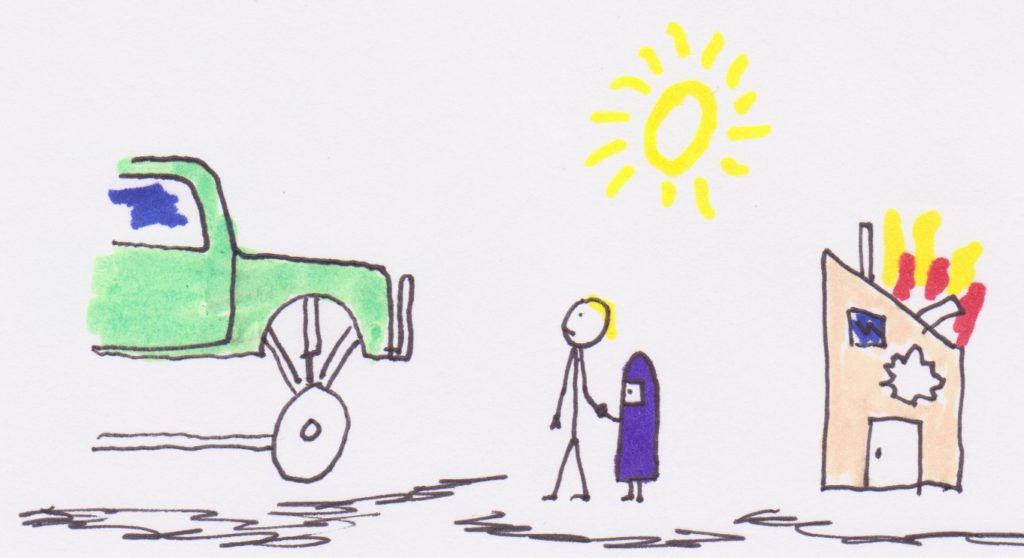
Here are two problems with an obvious solution. Operating a couple of aircraft carriers in a shuttle system, America can begin to move the unsold pickup trucks and SUVs, acre by acre, over to Baghdad. They’ll then be handed out to the Iraqis who have killed the fewest Americans that week, or who are the best at singing the new national anthem. Perhaps there should be some sort of point system. As time goes on, the Iraqis will be delighted with their new cars, and the money saved in firing expensive weaponry at them will more than pay for the cars themselves.
But it gets better than this, my friends. These cars were made in America. They will spend several weeks bouncing around in the hold of an aircraft carrier, after which they will be driven around on poorly-made roads in scorching heat. After a few weeks, these cars are going to need some serious maintenance work. A whole local economy will spring up around repair of American cars, and the US auto industry will be thrown into overdrive, barely able to manufacture and ship spare parts fast enough. The huge influx of extra income will allow them to invest heavily in alternative energy sources, propelling America’s car industry to the top of the heap once again.
I will probably be given the Presidential Medal of Freedom, at a ceremony where I will give a moving speech.